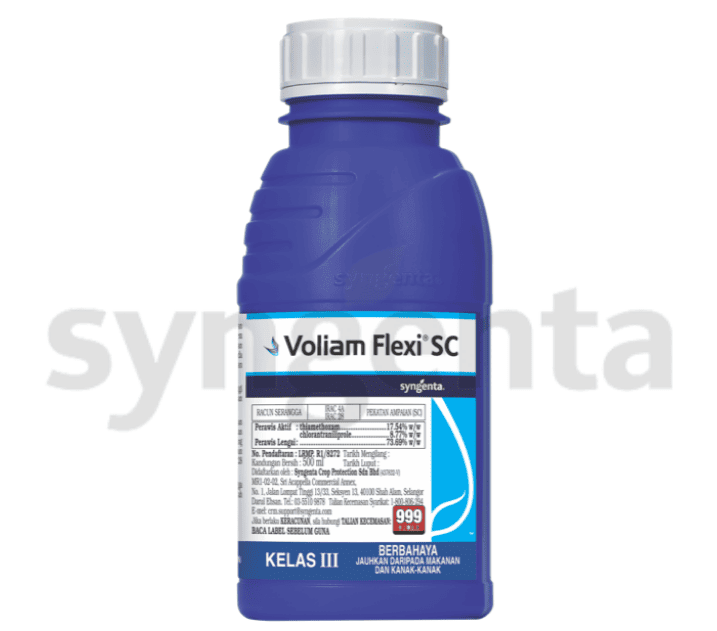
Voliam
Product overview
is a type of insecticide that contains active ingredients from the 'neonicotinoid' and 'diamide' groups that act translaminar and are absorbed throughout the tree through the xylem system systemically. It also acts by contact by blocking the feeding system of insect pests. This will prevent insect pests from sucking and chewing and no damage will occur to the plant and control insect pests that suck and chew.
Application Rate
| Crop | Insect Pest | Pesticide Rate | Spray Volume Per Hectare | Maximum Number of Sprays Per Season | PHI | |
|---|---|---|---|---|---|---|
| 10 Liter Water | Per Hectare | |||||
| Paddy | Stem Borer (Scirphopaga incertulas) Plant Leafroller (Cnaphalocrocis medinalis) | *2 - 3 ml *5 - 7.5 ml | 100 - 150 ml | 500 liter (bearing sprayer) | 2 times | 26 days |
| 200 liter (motorised sprayer) | ||||||
| Round Cabbage | Diamondback Moth (Plutella xylostella) | 3 ml | 150 ml | 500 liter | 3 times | 3 days |
| Chinese Cabbage | ||||||
| Kailan | ||||||
| Choy-sam | ||||||
| Eggplant | Whitefly (Bemisia tabaci) Potato Leafhopper (Empoasca fabae) Fruit and Shoot Borer (Leucinodes orbonalis) | 4 ml | 200 ml | 500 liter | 7 days | |
| Bread Bean | Maruca Pod Borer (Maruca testulalis) | |||||
Mixing Guide:
It is recommended to use a 5/64" hollow cone type bearing sprayer or a motorized sprayer. Fill the tank half full with clean water. Mix thoroughly according to the recommendations set out in the dosing table and mix. Then add the remaining clean water required and stir. Do not use at a rate higher than recommended. Do not store the remaining mixture in the sprayer tank.
Spraying Guide:
Apply when signs of infestation reach the action threshold level (ATL). For good control, spray thoroughly on the upper and lower surfaces of leaves. Repeat spray at 7-day intervals for cabbage, Chinese cabbage, kailan, choy-sam, eggplant and beans; at 14-day intervals for rice only when necessary. Do not apply more than 3 sprays per season for cabbage, Chinese cabbage, kailan, choy-sam, eggplant and beans; 2 sprays per season for rice. If repeated treatments are required, alternate with insecticides from different groups with different modes of action.
Resistance Management:
Some pests have the potential to develop high levels of resistance to the product after repeated treatments. Product use should follow a defined strategy for use and spray area as pest resistance development is unpredictable.
Syngenta encourages the use of “Stewardship” to ensure long-term effectiveness in pest control. To prevent the rapid development of pest resistance, avoid continuous spraying of insecticides across the entire life cycle of the pest, either using the same product or different products with the same mode of action. It contains Group 4A insecticides (thiamethoxam, which belongs to the neonicotinoid chemical class) and Group 28 insecticides (chlorantraniliprole, which belongs to the anthranilic diamide chemical class).
using a “window approach” to avoid continuous exposure of Group 28 insecticides to generations of pests that have the same mode of action. The total use of Group 28 insecticides should not exceed 50% of the crop life cycle.