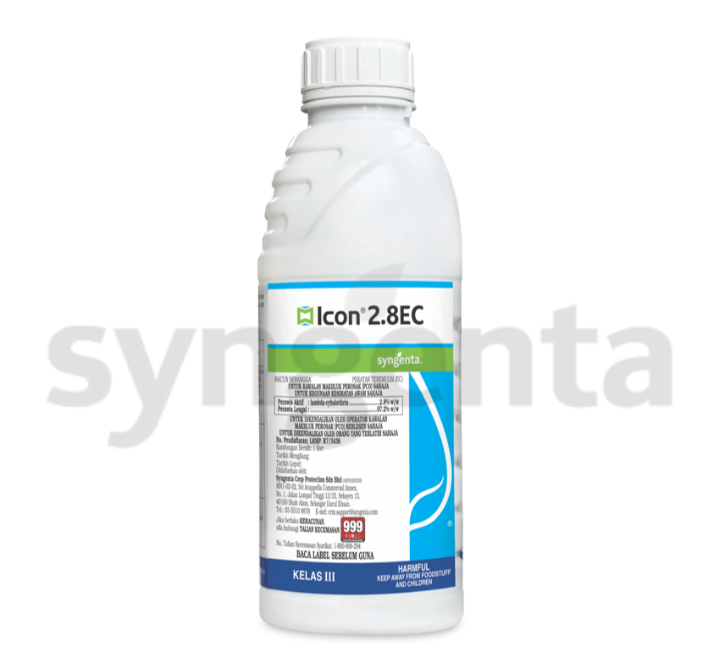
Icon 2.8EC
Product overview
is a type of insecticide containing active ingredients from the group of 'pyrethroids' which act by contact and stomach poisoning. It is suitable for use to control mosquitoes, flies, ants and cockroaches outside and inside buildings and residential areas.
Bearing Sprayer
| Treatment Area | Insect Pest | Rate | Note | |
|---|---|---|---|---|
| Pesticide Mixture | Spray Volume | |||
| 1) 'Residual' spraying outside and inside the building using a compression sprayer. | Mosquito (Anopheles maculatus, Anopheles letifer, Anopheles dirus, Anopheles sundaicus, Anopheles campestris, Anopheles balabacensis, Anopheles flavirostris), Flies (Musca domestica), Ant (Componotus saundersi), Cockroach (Blattella germanica) | 20 ml / liter air | 40 ml / square meter | Spray on floor surfaces and walls where insects often roam as well as cracks/ holes where they breed or hide. |
2) Space Spray a) Therma atomization - Hand Machine - Driving machine | Mosquito (Anopheles maculatus, Anopheles letifer, Anopheles dirus, Anopheles sundaicus, Anopheles campestris, Anopheles balabacensis, Anopheles flavirostris, Aedes albopictus, Aedes aegypti), Flies (Musca domestica) | 20 - 40 ml / liter kerosene or diesel | 2 liter / hectare | Use high levels of pesticide if the pest population is high. |
b) Cold Atomization - Ultra Low Volume (ULV) Spraying | 8 - 16 ml / liter kerosene or diesel | 5 liter / hectare | ||
| 80 - 160 ml / liter water or diesel | 0.5 liter / hectare | |||
3) Regular Spray (Bearing Sprayer) | Jaundice (Anopheles campestris, Anopheles maculatus, Anopheles letifer, Anopheles dirus, Anopheles sundaicus, Anopheles campestris, Anopheles balabacensis, Anopheles flavirostris) | 4 ml/ liter water | 100 liter / hectare | Spray on stagnant water areas. |
Mixing Guide:
It is recommended to use ULV machines, thermal foggers and roller sprayers. Fill the tank half full with water/diesel, mix thoroughly according to the recommendations set out in the dosing table and mix. Then, add the remaining water/diesel as required. Do not use at a rate higher than recommended. Do not store the remaining mixture in the sprayer tank.
Spraying Guide:
For best results, treatment should be done at dawn or dusk when the ambient temperature does not exceed 30˚C and the wind is not blowing strongly. For long-term control, insecticide spraying should be carried out in conjunction with cleaning the breeding area by collecting garbage and reducing insect breeding sites. Spraying should be done every 5 - 10 days in the initial stages. Thereafter, the frequency of spraying can be reduced to maintain the insect population at an acceptable level. Do not spray on/near food/food preparation areas including animal feed.
READ THE LABEL BEFORE USE